
Condensate-powered living façades
Born from air.Built for life.
We recover water already produced by air conditioning, then put it to work for greenery.
Follow the water STENOCARA
GRACILIPES
Before the system,
there was a beetle.
MAKE A SCARCE
RESOURCE COUNT.
In the Namib Desert, the fog-basking beetle turns passing moisture into survival. NAMIB takes inspiration from that resourcefulness—not by copying its shell, but by applying the same logic to buildings: find overlooked water and give it a purpose.
THE WATER IS
ALREADY THERE.
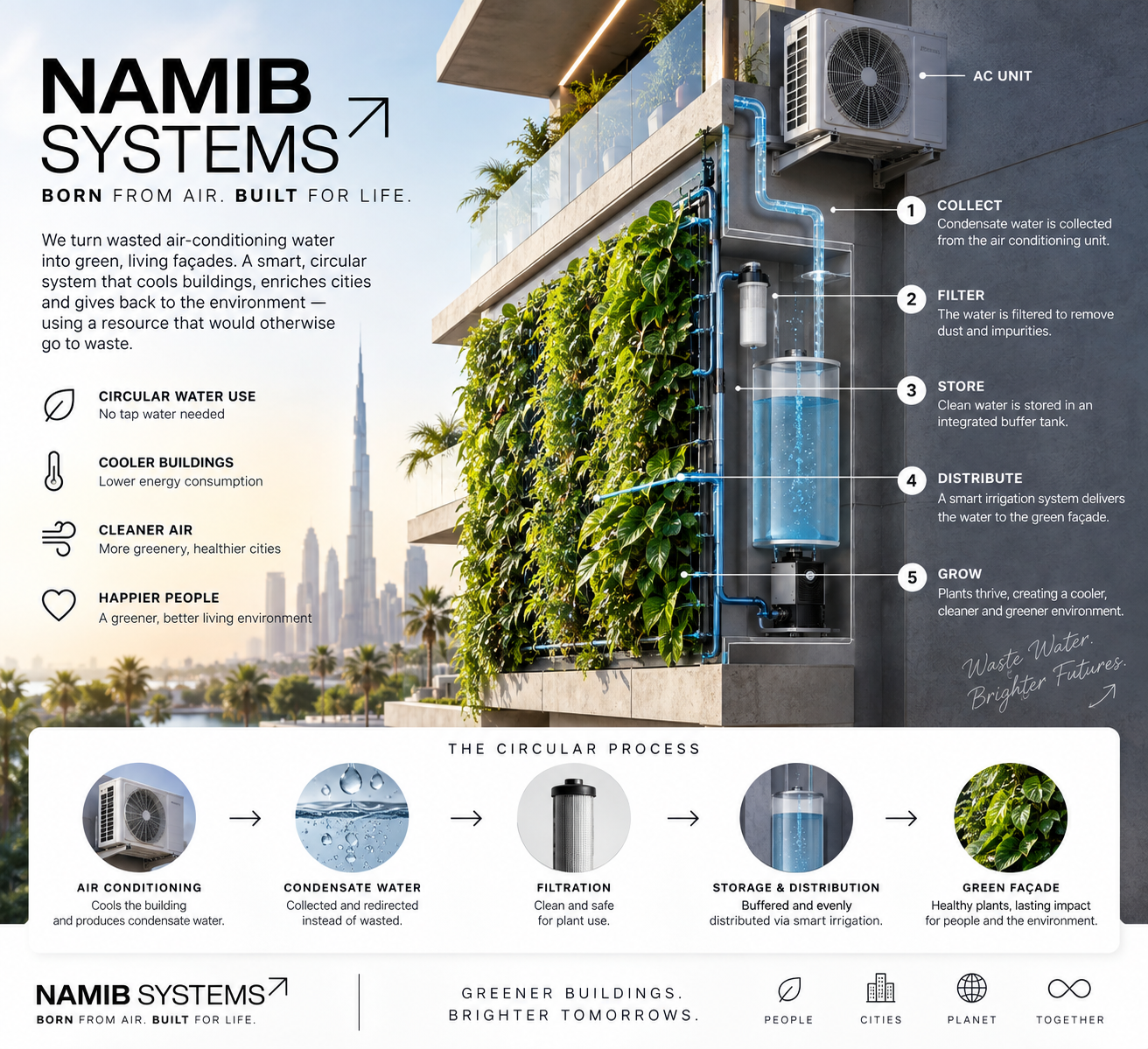
Air conditioning removes humidity from indoor air. That process forms condensate: water that is commonly sent to a drain. NAMIB begins with this existing building stream.
Not atmospheric water generation. Recovery from a building’s air-conditioning system.
ONE ROUTE.
FIVE DECISIONS.
Each stage has one job. Together they move condensate from source to planting.
- 01
Collect
Bring suitable condensate streams together.
- 02
Check
Understand quality and intended irrigation use.
- 03
Prepare
Treat and condition where the design requires it.
- 04
Balance
Use directly or hold a correctly sized reserve.
- 05
Deliver
Send water to the planting zones that need it.
View the full system overview +
DESIGNED AROUND
THE BUILDING.
The route is never imposed as a standard kit. Cooling equipment, drainage access, service routes, façade conditions and planting ambition determine the system architecture.
Trace what is available, then design the retrofit.
Coordinate water, planting and access from the start.
KNOW WHEN
TO MOVE WATER.
The useful question is not only how much condensate exists. It is whether supply, planting demand and timing align.
Direct usePrepared condensate moves to planting when supply and demand align.
WHAT COULD YOUR
BUILDING GROW?
A feasibility study connects available condensate to planting demand, timing and the realities of your building. The result defines what the project can responsibly support.
Assess the source
Map the route
Size the planting
Define the system